


The next time someone talks about limiting immigration, show them to them: almost half of American startups price a billion dollars were founded by people born outside the United States. Our research at the address Stanford ‘The V Venture Capital initiative shows that immigrant entrepreneurs not only contribute to the American innovation ecosystem – they assist to guide it.
44% of the American founders of the Unicorn are immigrants and India is leading
Analysis of 1078 founders of 500 US unicorns showed that 474 founders – 44% – were born outside the United States. Almost half of the most successful entrepreneurs in America got here from one other place.
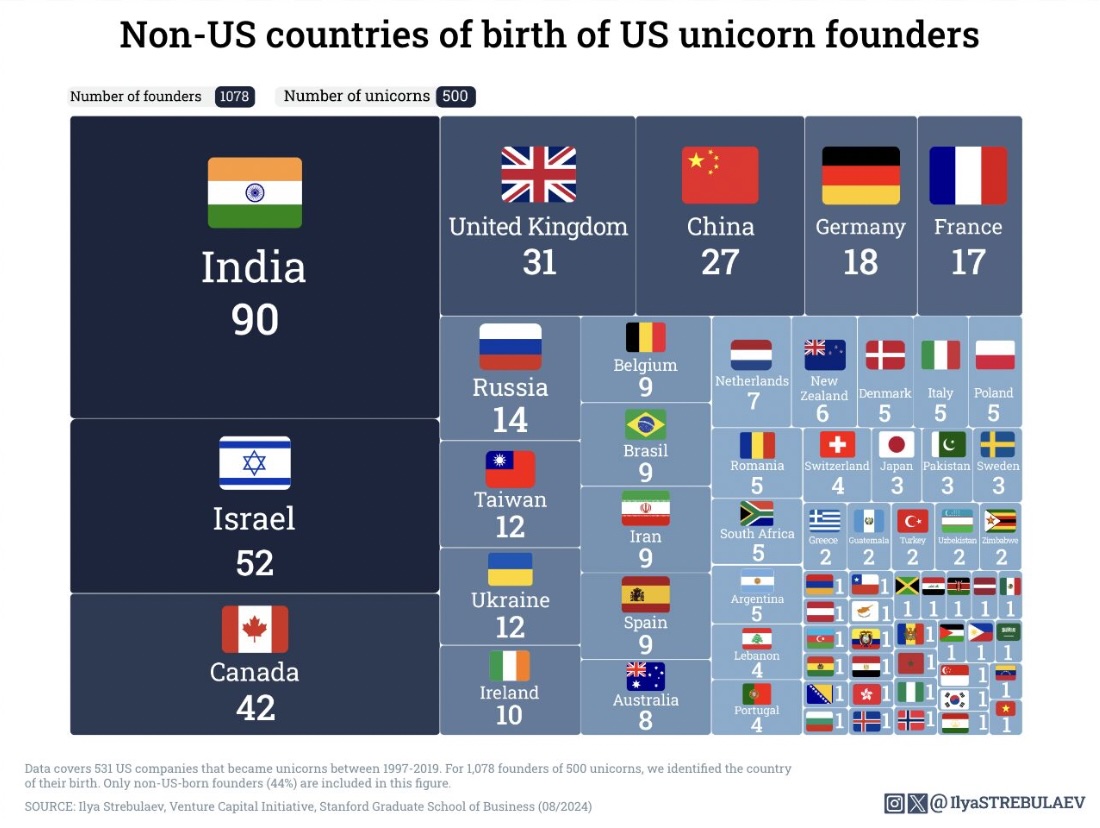
India are at the top of the list with 90 founders of the Unicorn, including Laks Srini With Trinet Zenefits AND Jyoti Bansal With Appdynamics.
Israel follows 52 founders, including Daphne Koller With CourserIN Adi Tatarko With HouzzAND Eyal Navon With Hippo insurance. We have 42 founders from Canada, including Stewart Butterfield With LooseIN Shane smith With Vice mediaAND Michelle Oslyn With Cloudflare.
The trend goes far beyond these best colleagues. Our research identified the founders of unicorns from 65 different countries covering six continents. Each region has its own distinctive:
- Europe: Great Britain (31 founders), Germany (18), France (17) and clusters from Belgium, the Netherlands, Spain and others;
- Asia: India lead, then China (27) and Taiwan (12), in addition to the contribution of Japan, Pakistan and elsewhere;
- Latin America: Brazil (9), Argentina (4) and Guatemala (2);
- Africa: South Africa (5) and Zimbabwe (2); AND
- Oceania: Australia (8) and New Zealand (6).
When Paul Maritz With Key software He got here from southern Rhodesia (now Zimbabwe), Amr Avadallah from Clouder from Egypt and Luis von Ahn With Large From Guatemala, they not only brought their talents – they brought various perspectives that helped them see the possibilities that others may miss.
Why move to America Works

It’s not only about who involves America – it is also about firms that make this move. Our data show that 8% of American unicorns (88 of 1108) were initially founded outside the United States before moving.

The relocation effect is powerful. Israeli startups that moved to the US were 9 times more willing to attain unicorn status than those who remained at home. This pattern also applies to other countries: Indian startups that moved to the US enjoyed a 6.5x advantage, and British firms recorded their probabilities by 2.5x.
These are not only statistics – these are stories of success, corresponding to Slack (from Canada), Unity (from Denmark) i Head (from Great Britain). This pattern suggests that although great ideas can start anywhere, the American ecosystem offers unique benefits of scaling.
Where do international unicorns land?

When international founders come to America, not everyone goes to the same place. While California stays a magnet that draws unicorns from around the world, we found interesting patterns in the place where firms resolve on themselves.
In the case of unicorns leaving Israel, New York often seems to be more attractive than California. Meanwhile, 15% of all unicorns in the US modified their headquarters at least once between the assumption and the status of a unicorn. The most typical destinations? California, New York, Massachusetts and Texas.
These location selections matter. Local ecosystems, regulatory environments and talents cost all the probabilities of startup success. For international founders, selecting the right location in the US might be as strategic as the decision to maneuver.
USA unicorns employ talents around the world, not only locally
The influence of international talents goes far beyond the founding teams. When we analyzed the locations of employees of 191 unicorns from California, we found that only 38% of 375,000 employees were in California. About a third were elsewhere in the USA, and almost a third was abroad.
India also stands out here, which is 6% of the global workforce of California unicorns – the best international concentration. Other noteworthy examples include Eventbrite17% of the workforce in Argentina, Thumbtack21% in the Philippines and Evernote12% in Chile.
Israeli immigrants create unicorns at the highest pace per capita
Here, the story becomes much more interesting. When we compared the number of unicorn founders from each country with their participation of first generation immigrants in the US population, we found striking varieties of “unicorn performance”.
Israel leads dramatically, with 43.4 founders of the Unicorn on 100,000 Israeli first generation immigrants. New Zealand is at 37.3 and Belgium at 24.4. For comparison, the India indicator is only 2.5 per 100,000 first generation immigrants, while Canada is 5.3.
This does not reduce India’s contribution – 90 founders of the unicorn is still the highest absolute number from any country. However, he suggests that various immigrant communities may have different tracks of entrepreneurial success in America, under the influence of aspects corresponding to education, skilled networks and access to capital.
Why does it matter: global roots of innovation
Our research is clear that the American innovation ecosystem develops on global talents. Almost even sharing between the US and immigrants suggests strong complementarity-various origin and perspectives connecting to create something greater than or they’ll do alone.
For decision -makers, the message is easy: attracting and maintaining global talent stays crucial for maintaining the edges of America in creating high height firms. For entrepreneurs, he suggests that the American dream of building a company changing the world stays very vigorous, regardless of where your journey began.
And for everyone interested in what drives innovation, our discoveries remind you that groundbreaking firms often appear when different worlds collide – when the founders bring perspectives from one context and apply them to challenges in one other.
Ultimately, the history of creating a unicorn in America is more and more global – where the best ideas and the most determined entrepreneurs find the technique to the ecosystem that helps them scale, regardless of where they were born.
Note on methodology and sources
In this study, we define unicorns as supported by American firms that have achieved a confirmed valuation price $ 1 billion after a statement in the private basic round or had a liquidity event (corresponding to IPO or takeover) with a confirmed valuation price $ 1 billion in the meantime 1997 and 2021. Crunchbase AND TechCrunchin addition to from data sets that report details about private events and liquidity, corresponding to Crunchbase, Pitchbook AND Venturesource. Then we manually confirmed and checked the data on the location and financing to determine to incorporate each company from our last unicorns list. This process caused a total of 1110 unicorns. For each unicorn, we also identified a peer company supported by VC, which raised its first round of the undertaking in the same 12 months. We call a sample of such peers with a random sample. For each company in unicorns and random samples, we identified the founders and co -founders (we use the “founder” and “co -founder” interchangeably from all the abovementioned sources, LinkedIn, public applications and many others. In total, we identified and confirmed 4975 founders (various data exercises can use the support of this data).