For some time now, I have been being attentive to the significant progress made by Australia, which is positioning itself as a strong competitor among the innovation ecosystems of the Asia-Pacific region.
The Scaleup Summit in AustraliaWhich Watch out for the bridge organizes every yr in October with the support Investment New South Walesprovides a good opportunity to take stock – also due to data and analyzes from “Scaling technology in Australia 2025”, a report published with the support of Crunch Base AND Action.
the Book of Numbers
Australia is home to 1,582 scaleups – almost six per 100,000 people, a remarkable number considering the country’s relatively small population – which have collectively raised over $36 billion in capital (about 2% of the country’s GDP).
Apart from the major Asian economies (over 2 billion people – China and India, which play in a different league with 12,403 and 4,112 transformations respectively), Australia’s numbers are not far behind South Korea (2,127) and Japan (2,268), roughly on par with Singapore (1,660) and 3 times larger than emerging ecosystems corresponding to the United Arab Emirates (503).
It’s value noting that Australia also stands out as fertile ground for large tech firms – we call them scalers. We identified 71 Australian scaleups, each of which raised greater than $100 million, a number comparable to Japan (86) and South Korea (96).
This may be explained by the relative isolation of the Australian ecosystem, which has encouraged the creation of national leaders in strategic sectors for the continent corresponding to construction, mining and energy – collectively generally known as “infratech”.
Infratech: an Australian home specialty
A more in-depth look at the infratech landscape shows regular growth over the past five years, with enterprise capital investment increasing from $100 million in 2020 to almost $500 million in 2025.

Among Australian scaleups, around 1 in 10 (107) operate in the industry, spanning the entire value chain: from critical assets (21%) to construction (57%) and energy systems (22%).

Australia’s dominance in AI mining
As highlighted in “Unlocking the way forward for mining” report produced by Mind the Bridge with support from Health and safetyAustmine i Mining Innovation Center in Peruand based on dozens of interviews with mining industry experts, large infrastructure projects promoted by local and international corporations (including ACCIONA, BHP and RioTinto) are increasingly integrating latest technologies corresponding to artificial intelligence, advanced robotics, computer vision and digital twins.
It is due to this fact no surprise that Australia leads the world, accounting for almost three-quarters of all AI investment for mining, well ahead of China (12%) and the United States (9%).
Australia’s dominance in artificial intelligence in mining reflects structural strengths that are difficult to match. The country combines large-scale mining operations, supportive regulations and a mature ecosystem of mining technology providers and talent that have made it a global center for mining innovation.
For firms overseas, which means access to AI mining capabilities now depends largely on working with Australian platforms and experts.

Investment landscape: industrial roots, corporate power
Investors are also entering technology areas corresponding to space technology, UAVs, drones and autonomous mobility, especially as they intersect with applications in construction and mining.
While the investor landscape in Australia is broad, with 491 energetic VC and CVC funds currently managing roughly $32 billion of dry powder available for local scale-up investments (see the map in the MTB Ecosystem) – continues to focus primarily on seed and early-stage financing (the majority of funds – 73% – are below USD 50 million).
However, what is particularly interesting – and consistent with the industrial dynamics of the Australian ecosystem – is that the majority of mega funds (over $1 billion) are corporate enterprise capital vehicles. Leading examples are Rio Tinto, in addition to banks corresponding to Macquarie Group, ANZ, National Bank of Australia AND Commonwealth Bank of Australia.
Specialization attracts international players, spread does not
Strong Australian specialization in specific industries is attracting interest from global corporations: 26 large multinational firms have established innovation outposts Down Under (map available in the MTB Ecosystem).
This sends a powerful signal in today’s world of innovation, where the concentration of investment in a few major ecosystems has effectively reduced the visibility of just about all others, pushing them towards marginalization and irrelevance.
Specializationwhether in technological fields or industrial applications, it may help some of those ecosystems stand out and take their place on the global innovation map.
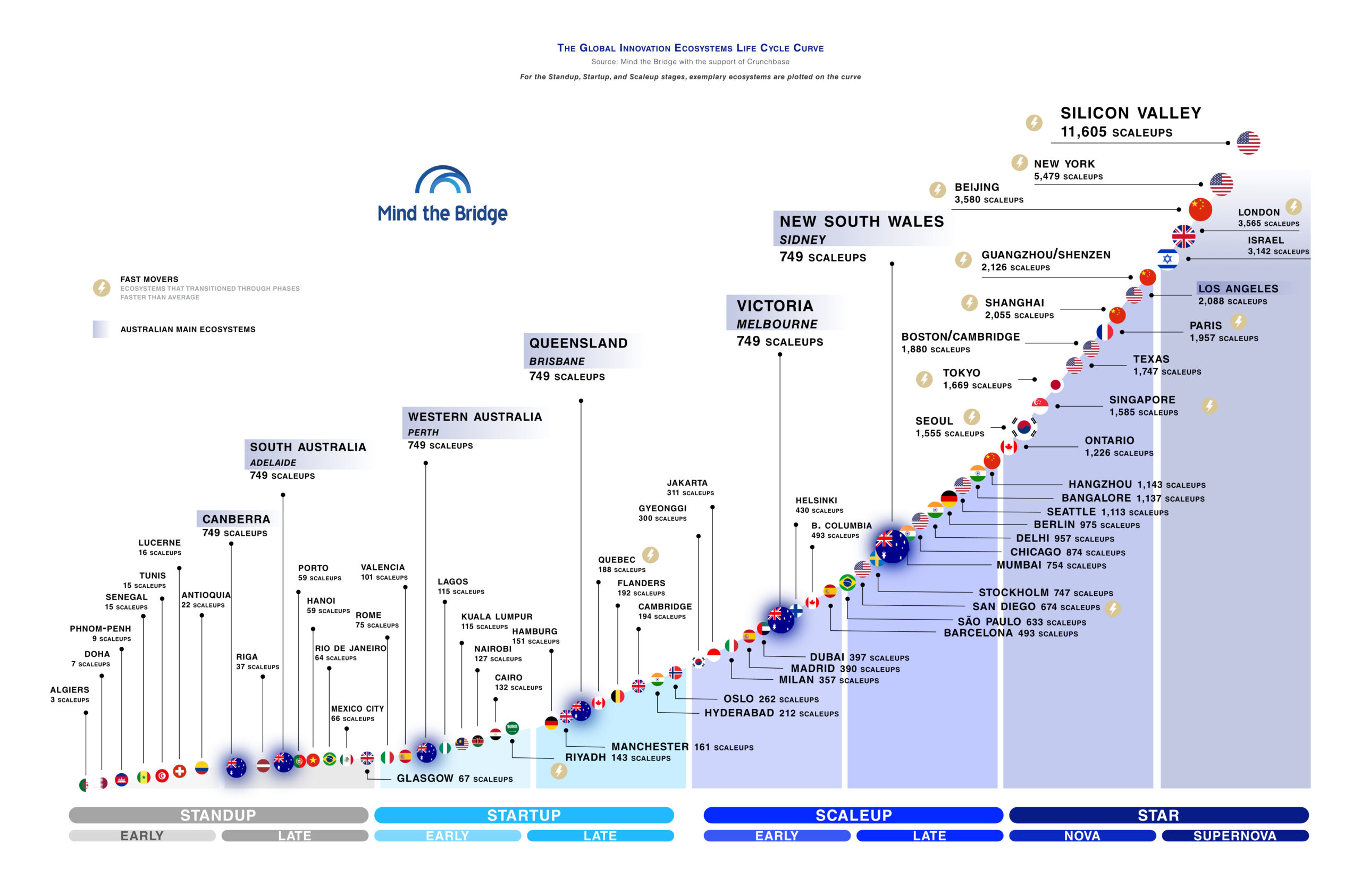
Learn more about startup ecosystems and scaling in Mind the Bridge reports (available for free download here).