


On this page Hustle Spotlight Q&A is Jaime Holm and Matt Hannula’s siblings. Holm is the founder and vice chairman of Design, and Hannula is the general director in Tinker Tinwhich manages experimental marketing and promoting projects for firms resembling Lexus and Hollywood sets resembling the infamous trailers of the Manson family in A protracted, very long time ago in Hollywood.
Holm began Tinker Tin as a lateral hustle and bustle over ten years ago while working in the Joe’s Trader and reminds you to receive phones about the company between bananas; In the end she had so many questions that she gave up her job to focus on the full -time enterprise. The answers were edited in terms of length and clarity.
Picture loan: Courtesy of Tinker Tin. Matt Hannula and Jaime Holm.
When did you begin your side hustle and bustle and how did you raise it?
Holm: I began Tinker Tin 13 years ago. I just got married and remembered the time spent on my life in a camper and browsing in Australia before my love and I began to meet. I used to be browsing the web to see if there are any campers or functions for rent in California on a trip. At that moment, the United States had things like RV America and possibly one other company that rented modern RV, but it was. I told my husband that we should always find an old trailer, fix it and rent it, identical to me when I used to be in Australia. He liked this concept. (He worked at the Hot Rod in highschool.)
From there, we got our first camper for $ 800 and became the first company trailer in the USA in the USA, which we quickly turned from the campsite rental to renting these vintage trailer for Hollywood Studios for movies and promoting. We began to receive calls for branded trailers to road shows of cosmetics firms resembling Lush or Pacifica, and we made activations for Facebook, Pepsi, Williams Sonoma, New Belgium and many others. Companies all the time ask us to build a retail display to pair with a trailer to present your product. At the starting of the company, they stopped asking for trailer rentals and began to ask for the design and construction of one other display of retail products, and then one other. It went from one to tons of to hundreds, not only to one retail SKU display, but for designing and building entire retail stores. In this fashion, we went from inspiring a historic campsite to a full -fledged design and production company.
If you would return to your enterprise trip and change one process or approach, what would it not be and how do you regret that you’re going to not do it in another way?
Holm: I can hire key positions faster. We are a zero -length company, so at the starting we saw slower development and [had] Some burnout from the skeleton team for longer than we should always probably. When my brother became the owner of the company and our general director, and I could go back and focus on what I do best without juggling the whole company – then our real growth began. Matt was able to implement production principles, our combined vision and much more to improve our development.
Hannula: Talent is so vital when scaling the company. Sometimes it is difficult to get good talent early, especially paying for it, but if I could interview people longer, asked more questions, conduct personality tests, etc., we’d save so much stress, time and money (actual cost and costs from errors and worse results).
I also regret shooting faster. While running and scaling the company, it often seemed that the death sentence released someone because I “thought” that I needed them. But in fact getting rid of bad semen or poor talent is exactly what I should do early to help on a higher scale, faster and more efficient.

Image loan: Courtesy of Tinker Tin
As for this specific business, what you think is particularly difficult and/or surprising that individuals who enter this type of work ought to be prepared, but probably are not?
Hannula: The devil is in detail, especially in production. There are so many moving parts that produce or break production. Binding it with building a specific product for the customer adds one other complexity. We all the time say here at Tinker Tin: “Do the right things, good.” Focusing on what we should always do and how to do it appropriately. There is no place for large production errors, because it is not only lost sales – it is a lost product. Pain associated with errors, and early awareness of these errors is very vital for success. You can quickly burn money, without doing it well. One unsuccessful screw can make the product useless.
Do you remember a specific case when something went very incorrect? How did you fix it?
Holm: At the starting, when we wanted to expand our retail customer base, we designed beautiful stores, retail displays and more for free. These decks were great and the customers were very pleased! As young entrepreneurs, we didn’t want to scare them out with design contracts or large production limits from the gate. We received a message that some retail customers are buying our projects in China or used the deposits for their investor council to make them look good, but they’ll never turn back with us. It was a big defeat on our parts, but it also gave us a lot of confidence in our possibilities. Instead of approaching deficiency, we treated this process as research and development and we were able to restructure, knowing that our worth and value adds to our clients, was not like that.
Hannula: I could write a book called Million Things that went incorrect, very bad! The one that comes to my mind, for the first time, began to produce large amounts of product in Mexico. Logistics is vital in Mexico, and the possession of reliable logistics partners throughout the entire supply chain is as critical as possible. In short, we had a bad partner in our supply chain, which ended in the loss of a Semitruck product value over USD 250,000 for about two weeks. The supply chain has died down. We caught a sheriff, the (*20*) of Justice and the CIA in local offices to shed light on the whole situation. Fortunately, because I’m the owner of a cyber security company, we were able to conduct a very detailed search for information throughout the entire supply chain and we received precious information that restored criminals back to the Internet. After this event, we fired our entire supply chain. The supply chain that has developed for over a 12 months, and we got rid of it immediately. It was painful, but 100% mandatory to make sure that it will never occur again.
How long did it take you with a coherent monthly revenues? How much did the lateral hustle and bustle earn?
HOLM: Fortunately, it was quite fast for us from the gate during the first 12 months. Our industry didn’t exist, so it was a large scenario with a small pond that was in our favor. In the first 12 months we made several hundred thousand. Our side Hustle turned into a real business that supported our family in the first 12 months, which was not what we expected or planned.
What does growth and revenues appear like now?
HOLM: We began with one employee on the payroll and the whole family of volunteers. We grew year-on-year, and 13 years later we are a company value $ 20 million without debts, and three of us in the family are now full-time-no more volunteers.
Hannula: When I entered Tinker Tin in 2018, a 12 months earlier we made $ 650,000. Now we have $ 20 million – and we’ll simply scratch the surface. Production is not a space to which everyone jumps. We are fresh and focused on the construction of tomorrow of the manufacturer. Nearby we found that we saw problems and tensions when China bubbling over a decade ago. We plan to proceed to strengthen our presence of domestic production in the USA and Mexico.
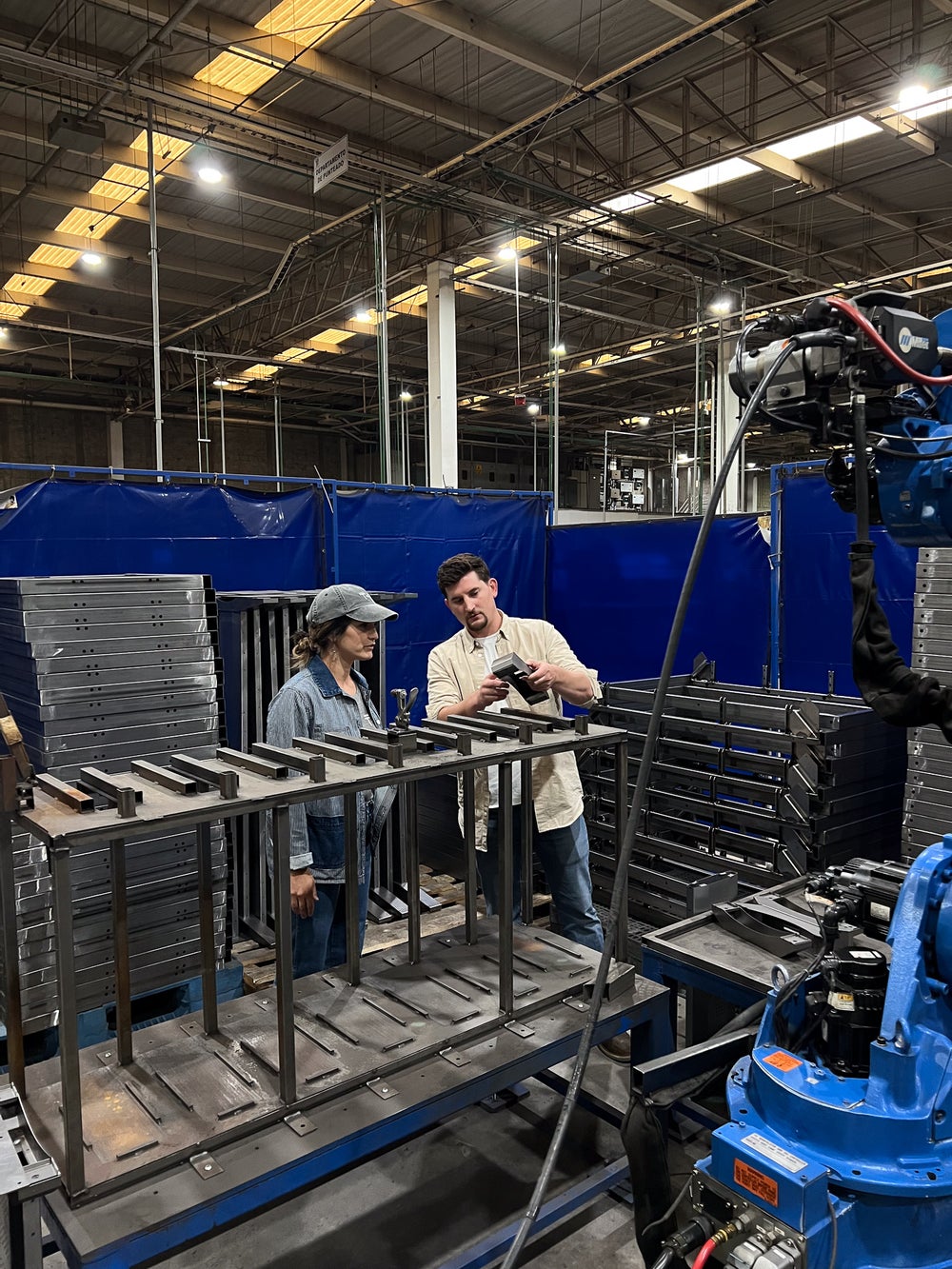
Image loan: Courtesy of Tinker Tin
What do you want best about running this business?
Holm: We hang a hat for “Beauty on a scale” and it is something that I absolutely love – to give you the option to design a retail display, which is not only quite rendering, but translates into a physical product that appears higher than digital. Nowadays, all the pieces looks nicer online compared to personally, but I consider in small details, small “who” in every project. This will excite me.
Hannula: Every day there is a recent problem to solve. For some it is stressful, exhausting and simply terrible and although I feel these emotions, I like all the challenges. My buddy entrepreneur once said: “Pressure is a privilege” and I couldn’t agree more. The pressure of running a successful business is one of the best privileges that may be experienced. Creating something for yourself you possibly can control and select all the pieces that sucks and winning a reward for all things that go well is just an amazing feeling. As all the time says Jaime, it’s about travel, not the finish line.
What is your best, useful business advice?
Holm: Don’t let your hobby take a place back, and if you do not have any hobby, don’t let your organization turn into your hobby. The hobby is your internal fire start, which helps hard working days. They help regulate your nervous system, can motivate or encourage recent ideas and can make it easier to check and re -check yourself and their truth. Loss of self -esteem in your organization does not help anyone, especially in business. Having a hobby allows you to separate yourself from your work in a way that invites you to a fuller creative side.
Hannula: It could also be trivial, but I have never experienced any higher advice than working in the ass. If you possibly can force yourself to work with your ass, crush him. Every success requires time and exertions. No one has ever hit Wu without forcing a bat. The more you wave the bat, the more effort you place into it every day, every week, every month, every 12 months (it is not overnight), [the more] You will go. You also have to commit! 100%. If you have an idea and try it for several months or a 12 months, then there is probably not enough time. If you have an idea, you hit hard and commit and do nothing else, you possibly can quickly succeed, but in the long term you’ll succeed.