


Executive summary
If social media taught us something, then recent technologies can have widespread and often unexpected effects. They can change not only the way we work, but also about how we think and how we relate to ourselves.
Artificial intelligence has unprecedented potential to shape our future in an exciting and unexpected way. As business leaders and government agencies around the world are struggling with responsibility for risk management accompanying the promised AI awards, one immediate and based on evidence Place is to begin building a varied board of directors. However, our research indicates that AI boards are very short on this front.
Councils that do not reflect a wide selection of experience and points of view are not well prepared to supervise firms whose products can determine how bank loans are assessed, how health care problems are diagnosed or how educational resources are allocated. Although no single agent can provide responsible development of artificial intelligence, the various leadership of the management board is of key importance for firms creating technologies that can generally transform the way of life, work and interaction.
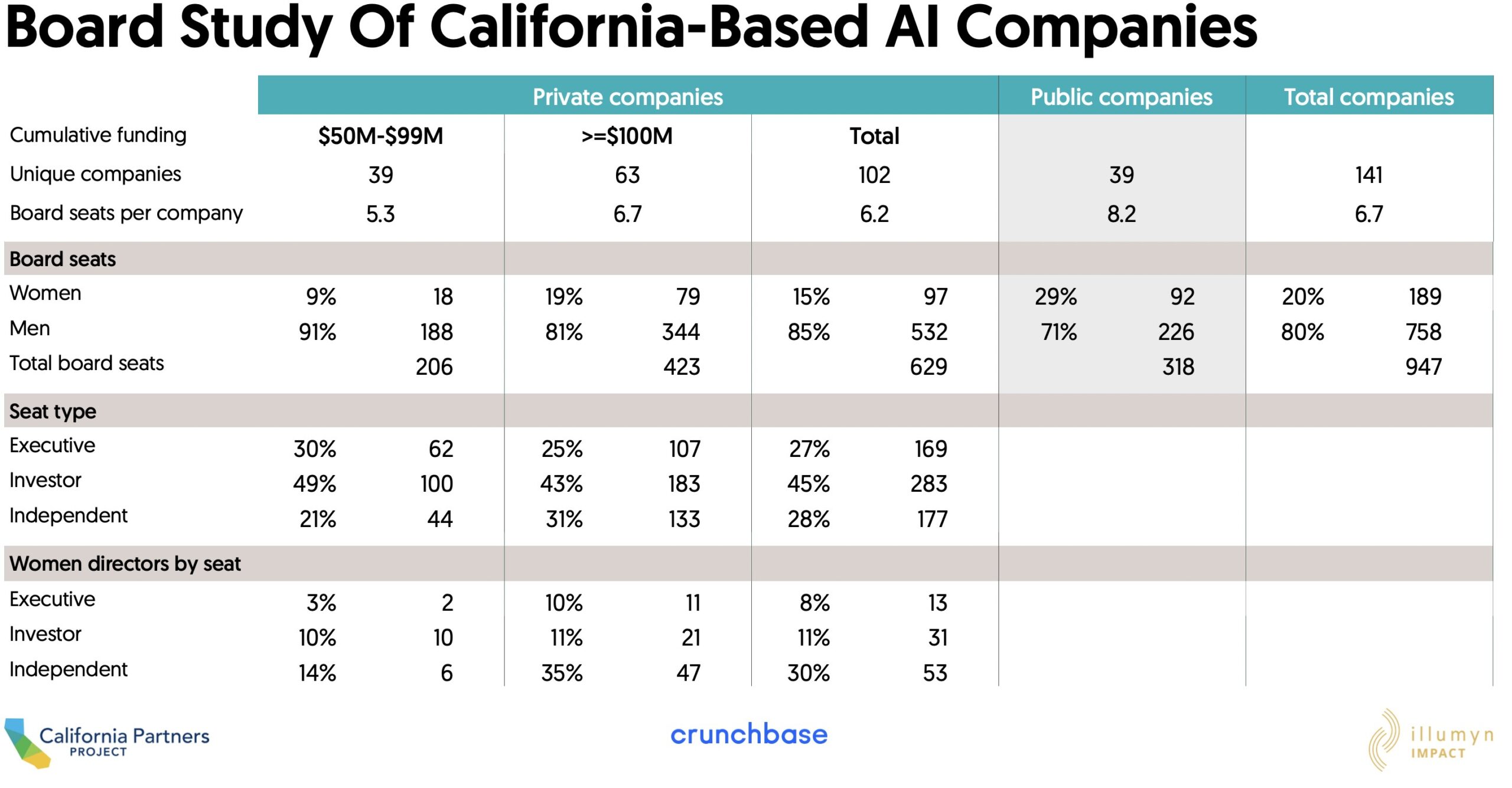
As part of this study, we glance at gender diversity, which is quite measurable as a deputy variety of perspectives, life experience, specialist knowledge areas and other demographic data. To understand a mix of sex on AI boards, we analyzed the composition of the management of over 140 AI firms based in California, where AI’s development supported by the undertaking is concentrated. Our study focused on 102 private firms that collected at least $ 50 million in cumulative financing. As we have seen again and again, transformational innovations are equally likely that they arrive from today’s initial startups, as from recognized industry leaders. Managing these firms during high growth, before IPO Probably equally vital Just like after public. We also looked at the boards of 39 publicly traded AI firms for comparative purposes.
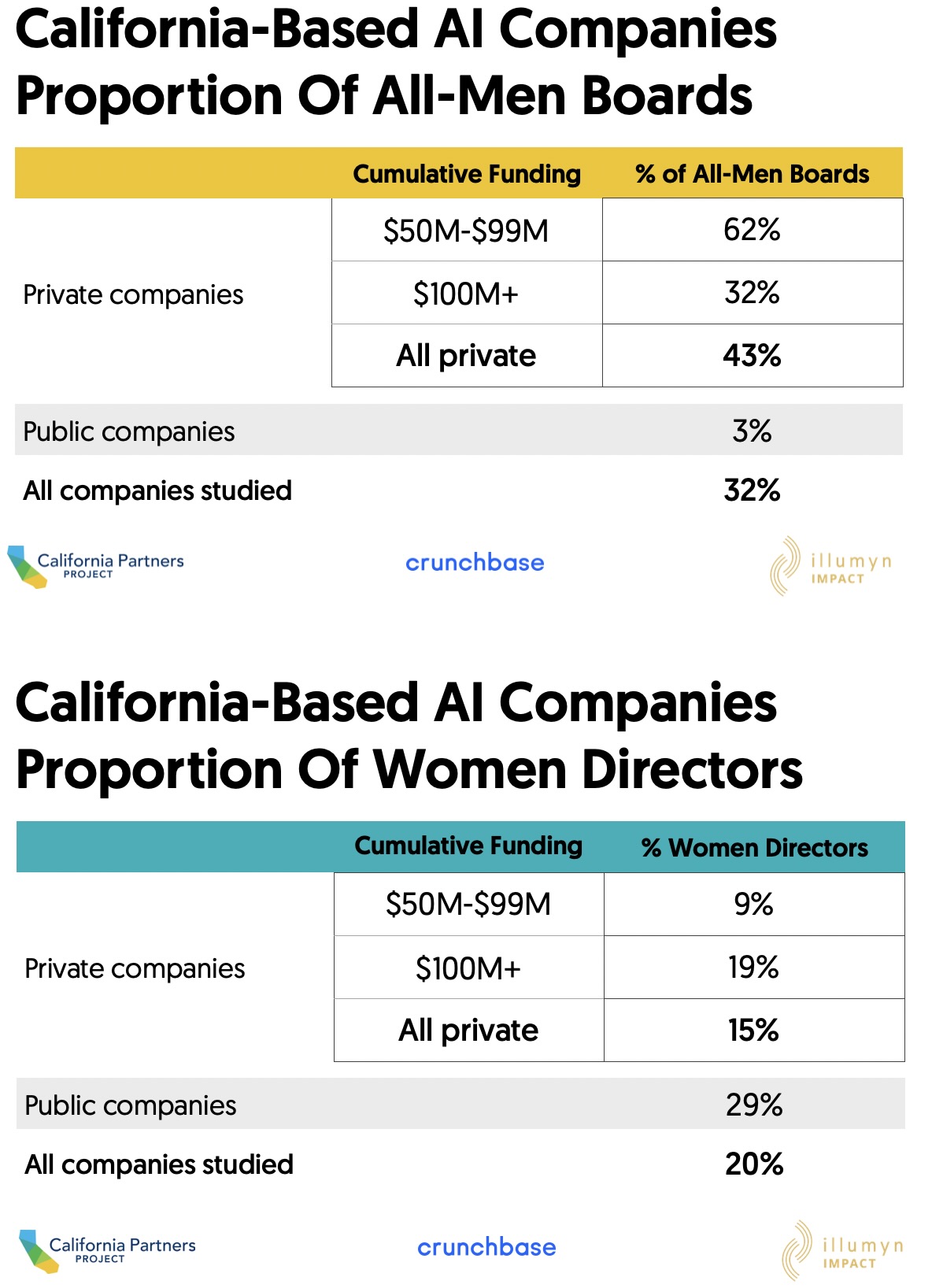
Our evaluation showed a striking lack of gender diversity among people ruling one of the most influential AI startups in the world. Women constitute only 15% of private management boards of AI. Over 40% of these private advice do not have any women’s directors.
The two major causes contribute to this gender difference – one structural and one behavioral. First of all, investors and founders jointly have most of the places for private board, and women are still insufficiently represented in these categories. Secondly, by appointing independent directors, advice often limits their consideration to well -known candidates as an alternative of looking for qualified experts outside their direct networks.
Good news: There are many women and colourful women and individuals who are able to bring their votes and support for specialist knowledge to the conference room.
Companies that prioritize building a varied board must only look beyond their existing networks to search out a wealth of talents of the AI management board. Consider this precedent: Five years ago one -third of all Public firms in California He had no members of the Women’s Management Board. By focusing and effort, boards are now a rare exception.
Given the rapid pace of the development of artificial intelligence, firms must now operate, while technology and its applications still appear. General directors and members of the management board who bring more women and colourful people to their conference rooms, will help create for all of us a productive and healthy future powered by artificial intelligence.
Key arrangements
Among the AI firms based in California included in our study:
- 15% of private board members are women;
- 43% of private company management boards do not include any women’s directors;
- Women who serve in private company management boards are most probably to occupy an independent place;
- 26% of private firms’ management boards do not include any independent directors; AND
- Companies recorded publicly normally have more diverse sex advice than private firms, but still on average two women for an eight -person management board.
On average, women only one place in AI conference rooms
In all surveyed private AI firms based in California, women have an average of one place on a board of six. Of the 102 private firms, only five boards (5%) have an equal or more women than men in the conference room.
Over 40% of private AI firms have the Management Board
Of the over 100 private AI firms based in California included in our study 44 (43%) there are no women in the conference room.
The variety of sexes is barely higher in the management boards of firms with greater capital. Among people with total financing in the amount of at least $ 50 million, but lower than $ 100 million, 62% have boards for all male. In the case of firms with financing at least $ 100 million, this number drops to 32%. This change probably results from the addition of independent directors who bring specialist operational and market knowledge.
Among the firms listed on public firms, women occupy an average of two places in the management board, twice as high as private management boards. Tests He suggests that in order to capture the economic advantages of diversity, the boards should include at least three women’s directors. Only half of the public firms we studied meets this threshold.
In the case of private management boards of firms, independent directors’ nominations offer the fastest path to diversity
Most private management places (72%) are run by the company’s management (normally the general director and co -founders) and early investors. Women have only 10% of these management places, which reflects the insufficient representation of women among Venture Capital investors and entrepreneurs financed by them. Women have lower than 20% of the roles of investment partners in Venture Capital. Companies with founders only secured only 3% of AI Venture financing in 2023, which from 2015.
Over half (55%) of women’s directors covered by our survey have independent places on the board. This implies that they are not associated with the founder team or company management or investors in the company. While public firms must have a minimum number of independent directors, private firms do not have such requirements. That is why independent directors are normally added later in the company’s life cycle, often as part of the preparation for IPO. The percentage of firms without independent directors decreases as the financing level increases – from 36% for people with 50 million to 99 million to 21% for people with 100 million USD or more.
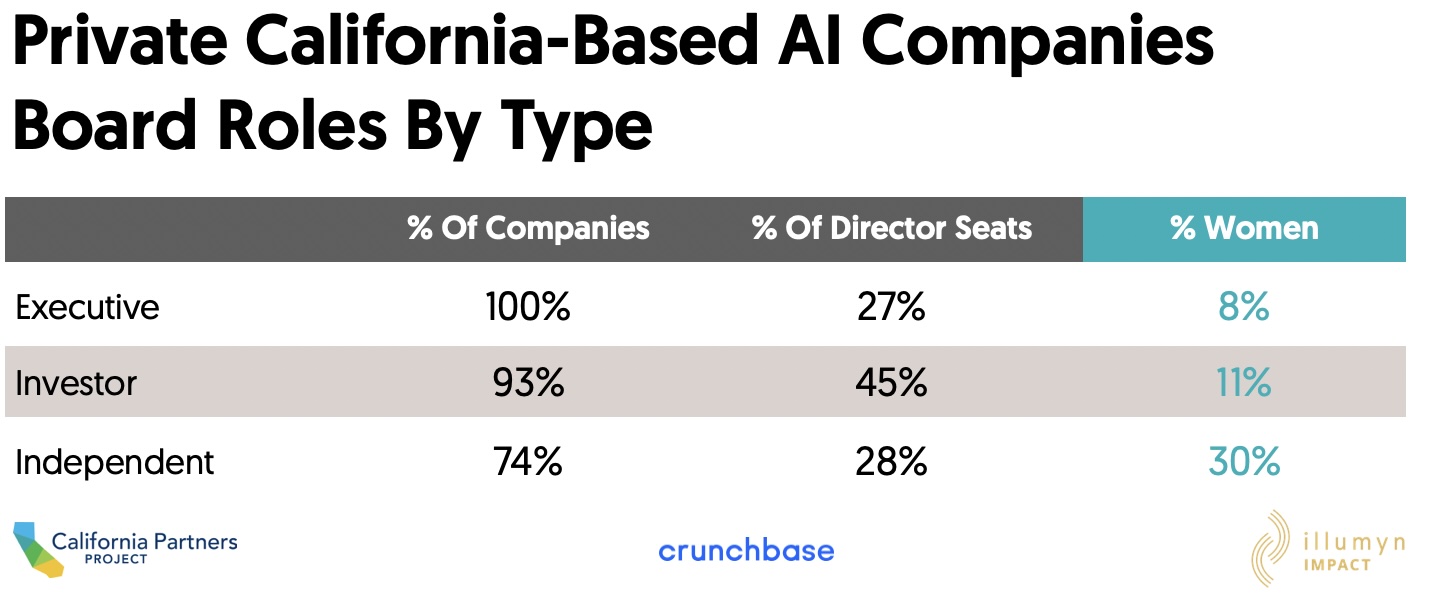
Our findings suggest that girls are more likely that they can be appointed to the private company AI Council as the second independent director. On boards with one independent director, a woman has 17% of independent places of directors. Among the firms with greater than one independent director, 67% had at least one woman in this role.
Abstract
Women are insufficiently represented on the management boards of AI-partly developing startups. Although the variety of management is not a panacea, it is one of the vital elements for firms developing technology with the potential of impact on society in a deep way.
To increase the number of members of the Women’s Management Board, firms should:
- Accelerate the appointment of independent directors;
- Undertake so as to add directors who extend the variety of perspectives, skills and experience in the board; AND
- Acquire existing networks to discover well -qualified candidates.
Companies do not have to pronounce technical knowledge and management experience to introduce various voices to their AI conference rooms. They just have to look beyond their direct networks.
Methodology
This study is a consequence of the methodology used in annually for her and Crunchbase Studies of Diversity on private company boards.
Using the Crunchbase database, we identified 409 firms in the AI industry based in California. Among them were 40 firms listed on the stock exchange and 369 private firms with at least $ 50 million in cumulative financing as at July 1, 2024. To make sure that the board profile of each company was current, we only included firms that publish the management board on their website.
Then we referred to the data of the company’s website, Crunchbase profiles and other publicly available information to characterize board members. The study covered only management directors; Observers and/or board advisers have been excluded from the data set. In the case of private management boards of the company, we shared board members in accordance with the type of management board: director, investor or independent. In a few cases, in which the founders and previous managers remained on the board, despite the incontrovertible fact that they now not played an operational role in the company, we classified them as “executive directors” in recognition of their original relationship with the company. We identified sex, referring to skilled profiles in Crunchbase and, if not available, other pages.